The performance of Rosendale Natural Cement® has been well-documented over the course of its long history of use. The following are typical performance data from a variety of historic sources. Modern test programs are in progress at a number of sites in the United States and in Europe. Results will be reported here as they become available.
Performance

| PROPERTY | RESULT |
|---|---|
| Set Time | >30 minutes (ASTM C10); Faster set than Portland cement, Much faster than hydraulic lime |
| Compressive Strength | Minimum 1020 psi (7 MPa) @ 28 days (1:1 with test sand) Lower initial strength than Portland cement, Comparable strength to Lime/Portland Blends and Hydraulic Lime |
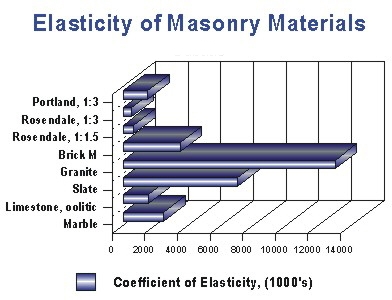
| Modulus of Elasticity | Typically 535,000-640,000 psi Lower than stone, brick, Portland cement (See chart) |
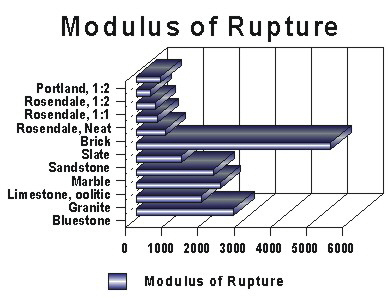
| Modulus of Rupture | Typically 400-600; Lower than stone, brick, Portland cement (See chart) |
| Fineness | Fineness specifications for traditional cements became increasingly stringent over time. Today there is no fineness requirement, only a minimum 28-day strength requirement. Typically a minimum of 70% passes a 200 mesh sieve. |
| Tensile Strength | Traditional Specifications required a minimum of: 38-70 psi @ 24 hours (neat) 87-134 psi @ 7 days (neat) 162-237 psi @ 28 days (neat) 34-50 psi @ 7 days (1:2 w/sand) 75-80 psi @ 28 days (1:2 w/sand) There is no current requirement. |
| Adhesive Bond Strength | CROTON BRICK Neat Cement: 68 psi 1:1 Cement/Sand: 40 psi 1:2 Cement/Sand24 psi FINE CUT GRANITE Neat Cement: 27.5 psi 1:1 Cement/Sand: 20.8 psi 1:2 Cement/Sand12.0 psi NOTE: These values are higher than results for lime and Portland cement. |